The Airplane on a Treadmill
An airplane stands on a runway that moves like a giant conveyor belt. The belt always runs backward, exactly as fast as the airplane rolls forward. Can the airplane take off? Few puzzles have started more arguments. Here is a story about one of them, followed by the physics that settles it for good.
The Bet at Hangar 4
It had been raining since morning, and nobody at the little airfield was flying. In the pilots' lounge above Hangar 4, three people were killing time over cold coffee.
Luka, the flight instructor, had four thousand hours in his logbook and a habit of saying nothing until he was sure. Mila was an engineering student who washed airplanes on weekends to pay for her flying lessons. And Stefan drove the fuel truck, knew every pilot by name, and believed every word he read on his phone.
"Listen to this one," Stefan said, scrolling. "An airplane is on a runway that can move, like a treadmill. The treadmill runs backward at exactly the same speed the plane rolls forward. Can the plane take off?"
"No," he answered himself before anyone else could. "It's the gym. You run on a treadmill, you go nowhere. The plane goes nowhere, no wind over the wings, no lift. Done."
"It takes off," said Mila, without looking up from her notes.
"Then you've never been to a gym."
Luka smiled into his cup. He had watched this exact argument ruin friendships on internet forums for twenty years.
"Think about what pushes you on the treadmill," Mila said. "Your feet. You push the belt backward and the belt pushes you forward. If the belt runs away under you, your push is wasted. A car is the same: the engine turns the wheels, the wheels push on the road. Put a car on a treadmill and it stays put."
"So the plane stays put too."
"Does the engine of that Cessna turn its wheels?" She pointed through the window at the little high-wing airplane parked on the line. "The engine turns the propeller. The propeller grabs air and throws it backward. The airplane is pulled forward by the air, not by the ground. The wheels are just there so the belly doesn't scrape. They spin freely, like the wheels of a suitcase."
Stefan was not convinced. Stefan was never convinced on the first try. "Prove it."
Mila took a toy airplane off Luka's shelf, laid a long sheet of printer paper on the table and set the toy on it. "Pull the paper towards you. As fast as you like." She placed one finger behind the toy's tail. Stefan pulled. The paper slid, the tiny wheels spun in a blur, and Mila's finger pushed the toy steadily forward across the table as if the paper did not exist.
"My finger is the propeller," she said. "It pushes against something that isn't the paper. The paper can only make the wheels spin faster."
"A finger isn't an engine," Stefan said, but quieter now.
That was how the bet was born. Loser washes every airplane on the line for a month.
On Sunday the wind was dead calm and the windsock hung limp. Luka rolled out the club's ultralight. Stefan hitched a long vinyl tarp to the back of his fuel truck, the same trick the MythBusters had used on television years earlier. Luka lined up on the tarp, Stefan drove off in the opposite direction, pulling the tarp backward under the airplane's wheels faster and faster.
Luka opened the throttle. The little wheels became a grey smudge. The ultralight did not care. It rolled forward against the moving tarp, gathered speed, lifted its nose and climbed away after a run no longer than usual.
Stefan stood by his truck for a long time. Then he walked over to Mila.
"Okay. But what if the treadmill matches the speed of the wheels, not the plane?"
Mila laughed. "Then your treadmill would have to accelerate at seventeen g and break the sound barrier in about two seconds. The tires would explode long before the airplane noticed. Bring a sponge on Monday."
He did.
The Problem
The puzzle is usually stated like this:
An airplane is standing on a runway that can move, like a giant conveyor belt. The belt is controlled so that it always moves in the opposite direction at exactly the same speed as the airplane. Can the airplane take off?
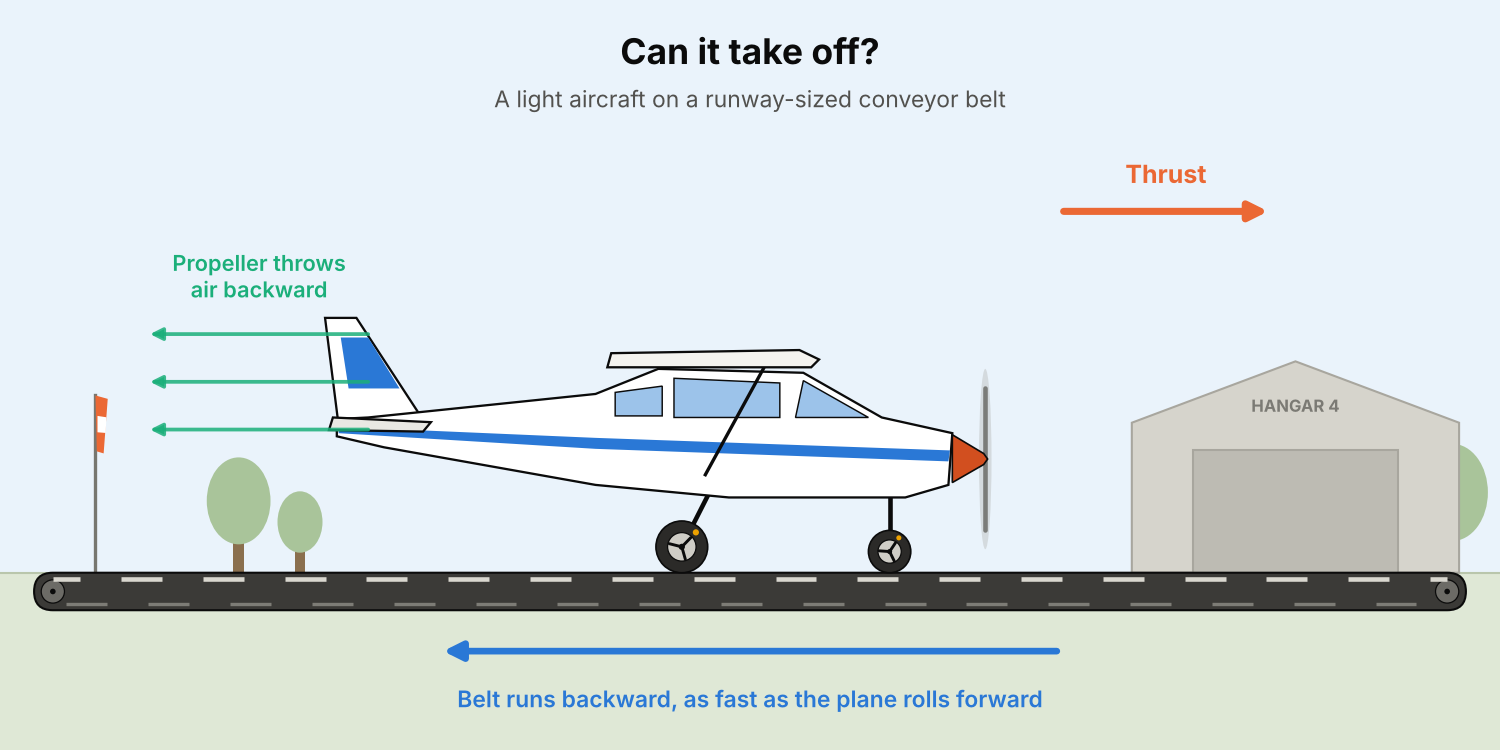
Figure 1. The setup. The propeller throws air backward; the belt runs backward under the wheels.
The puzzle spread across internet forums in the mid-2000s and divided people almost exactly in half. In 2008 the television show MythBusters tested it with a small ultralight airplane on a long tarp pulled backward by a truck. The airplane took off normally.
There are two ways to read the wording, and they matter:
- Reading A, the practical one: the belt moves backward at the same speed the airplane moves forward relative to the ground.
- Reading B, the literal "wheel speed" one: the belt moves so that its speed always equals the speed of the wheels' rims. As we will see, this reading describes a machine that cannot exist.
The Short Answer
Yes, the airplane takes off. In Reading A it takes off after almost exactly the same distance and time as on a normal runway. The only visible difference is that its wheels spin twice as fast. Reading B is not a question about flight at all; it is a question about whether you can destroy a set of landing gear with an absurdly violent conveyor belt.
Why Intuition Says "No"
Our everyday experience of moving is through the ground. When you walk, run, cycle or drive, you push backward on the ground and the ground pushes you forward. A treadmill defeats that push by moving the ground away under you. A car on a treadmill behaves exactly like a runner: its engine drives the wheels, the wheels push on the belt, and if the belt runs backward fast enough, the car stays in place.
An airplane does not push on the ground at all. Its engine drives a propeller (or, in a jet, a fan and a jet of exhaust), and that pushes on the air. The wheels are not connected to the engine. They are free-rolling wheels on bearings, exactly like the wheels of a shopping cart or a suitcase.
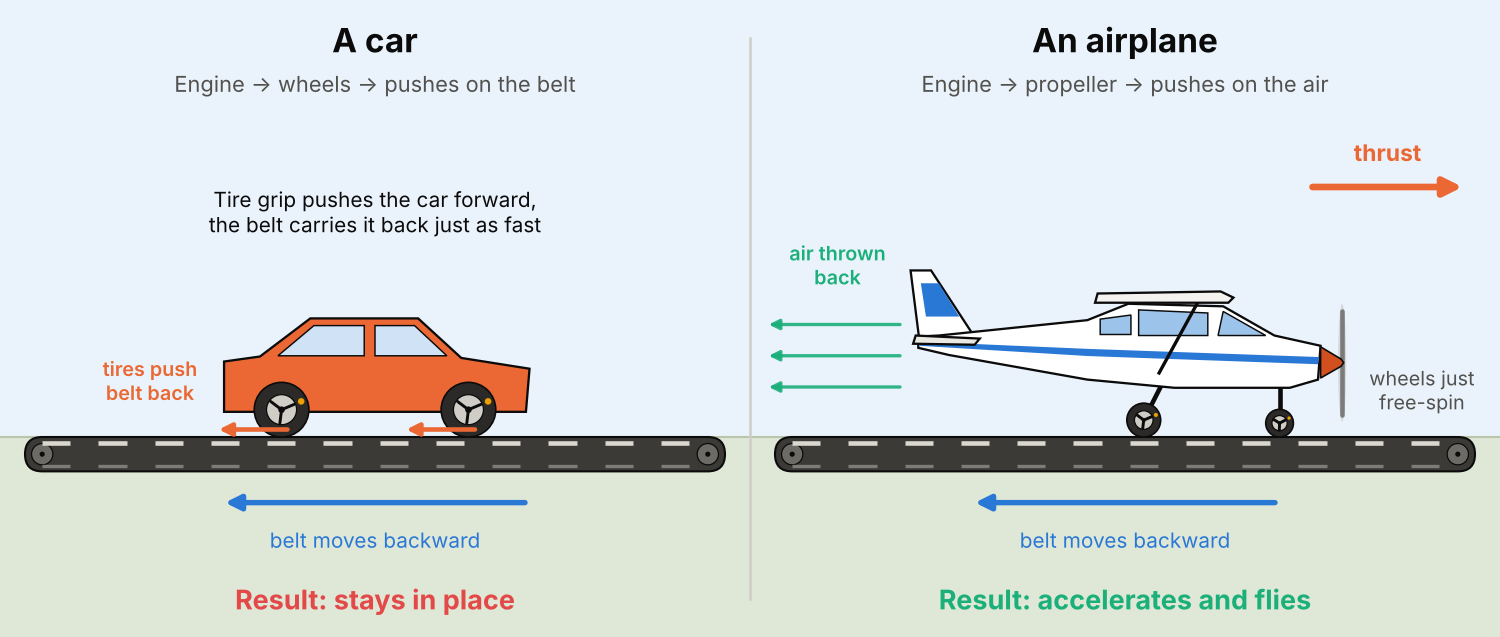
Figure 2. The whole puzzle in one picture: the car's force goes through the belt, the airplane's force goes through the air.
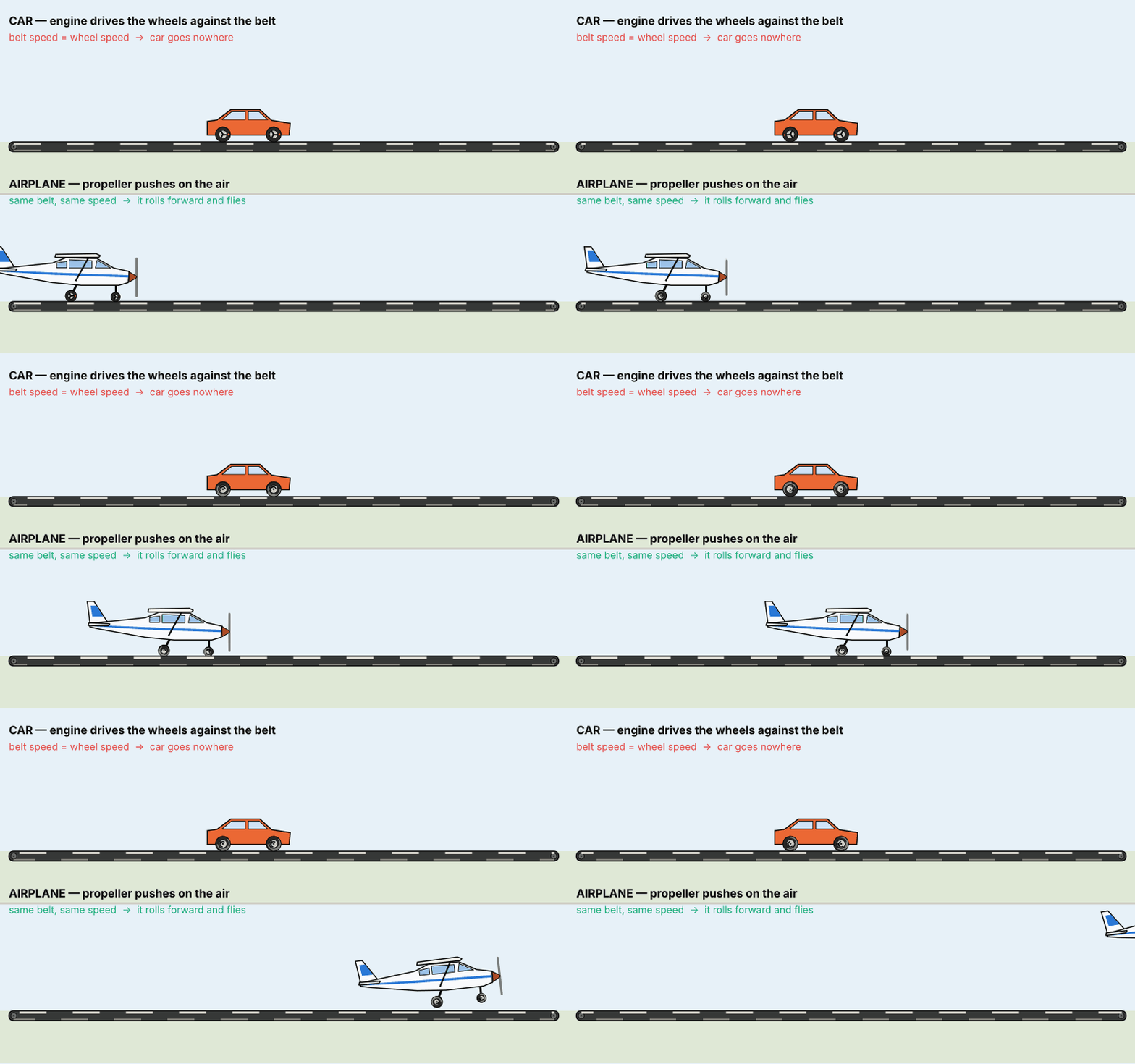
Animation 1. Same belt, same speed. The car goes nowhere; the airplane rolls forward and flies.
The Physics Behind the Answer
1. Where thrust comes from
Newton's third law says that every force comes in a pair. A spinning propeller is a rotating wing: it grabs a large mass of air every second and accelerates it backward. The air pushes the propeller forward with an equal and opposite force. That force is thrust.
Thrust = (mass of air moved per second) × (how much faster it leaves than it arrived)
A Cessna 172 class airplane produces roughly 2,000 N of static thrust at full power. Nothing in that equation involves the ground or the wheels. The engine would produce the same thrust if the airplane were hanging from a crane.
2. What the wheels actually do
A free-rolling wheel can only pass a small horizontal force to the airplane. That force comes from two places: rolling resistance (the tire flexing as it rolls) and friction in the wheel bearings. Rolling resistance is usually written as:
Froll = μrr × N
where N is the weight resting on the wheels and μrr is the rolling-resistance coefficient, about 0.02 for an aircraft tire on concrete. For our 1,100 kg airplane that is about 200 N at the start of the run, and it shrinks as the wings take over more of the weight.
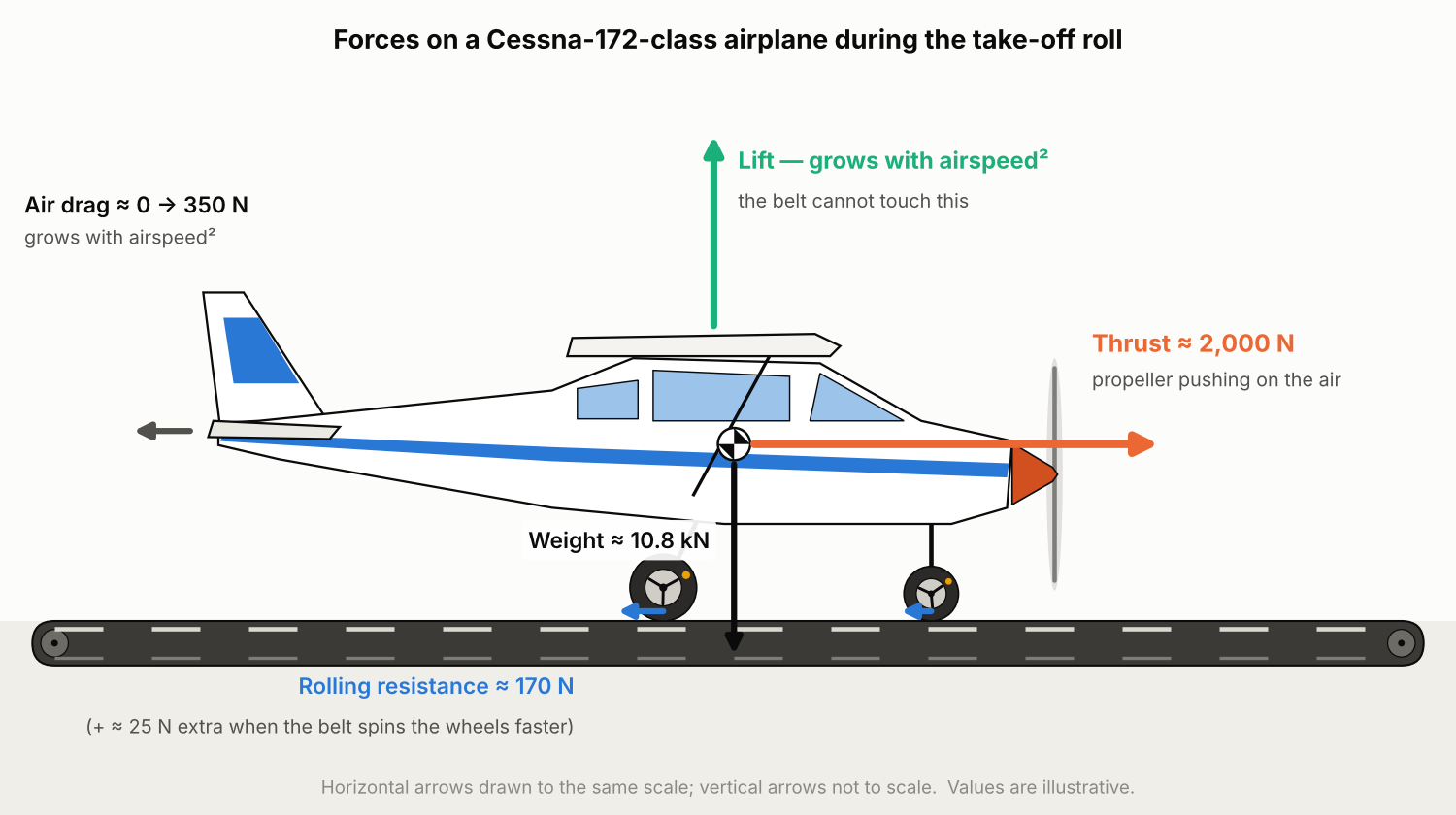
Figure 3. Forces during the take-off roll. Thrust is about ten times bigger than everything the wheels can do.
The treadmill does change one thing: the wheels now spin faster, so tire flexing and bearing friction rise a little, and the belt has to spin the wheels up as it accelerates. Together these add only about 25 N of extra drag, roughly 1% of the thrust. The airplane barely notices.
You can feel this at home. Put a toy car on a sheet of paper and hold it lightly with one finger. Pull the paper away as fast as you can: the wheels spin wildly, but your finger hardly feels anything. Your finger is the propeller.
3. Who moves relative to what
The confusion often comes from mixing up speeds. There are three of them:
- the airplane's speed relative to the ground (and the still air), v;
- the belt's speed relative to the ground, vbelt;
- the speed of the wheel's rim relative to the axle, which sets how fast the wheel spins.
The bottom of a rolling tire does not slip on the surface beneath it, so the rim speed is simply the difference between the axle's motion and the surface's motion:
rim speed = v + vbelt
On a normal runway vbelt = 0, so the rim speed equals the airplane's speed. On the treadmill in Reading A, vbelt = v, so the rim speed is 2v. The wheels spin twice as fast; the airplane moves exactly as it would anyway.
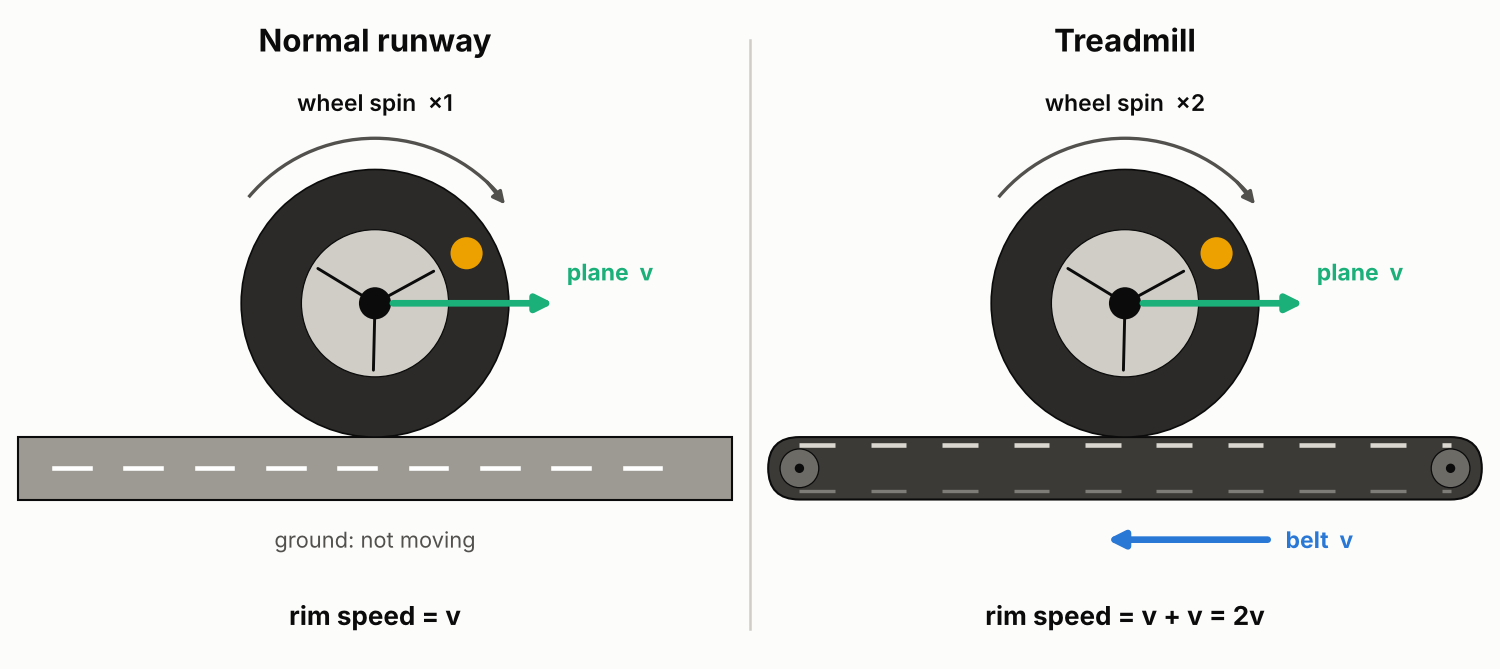
Figure 4. On the treadmill the wheel has to make up for both the airplane's motion and the belt's motion, so it spins twice as fast.
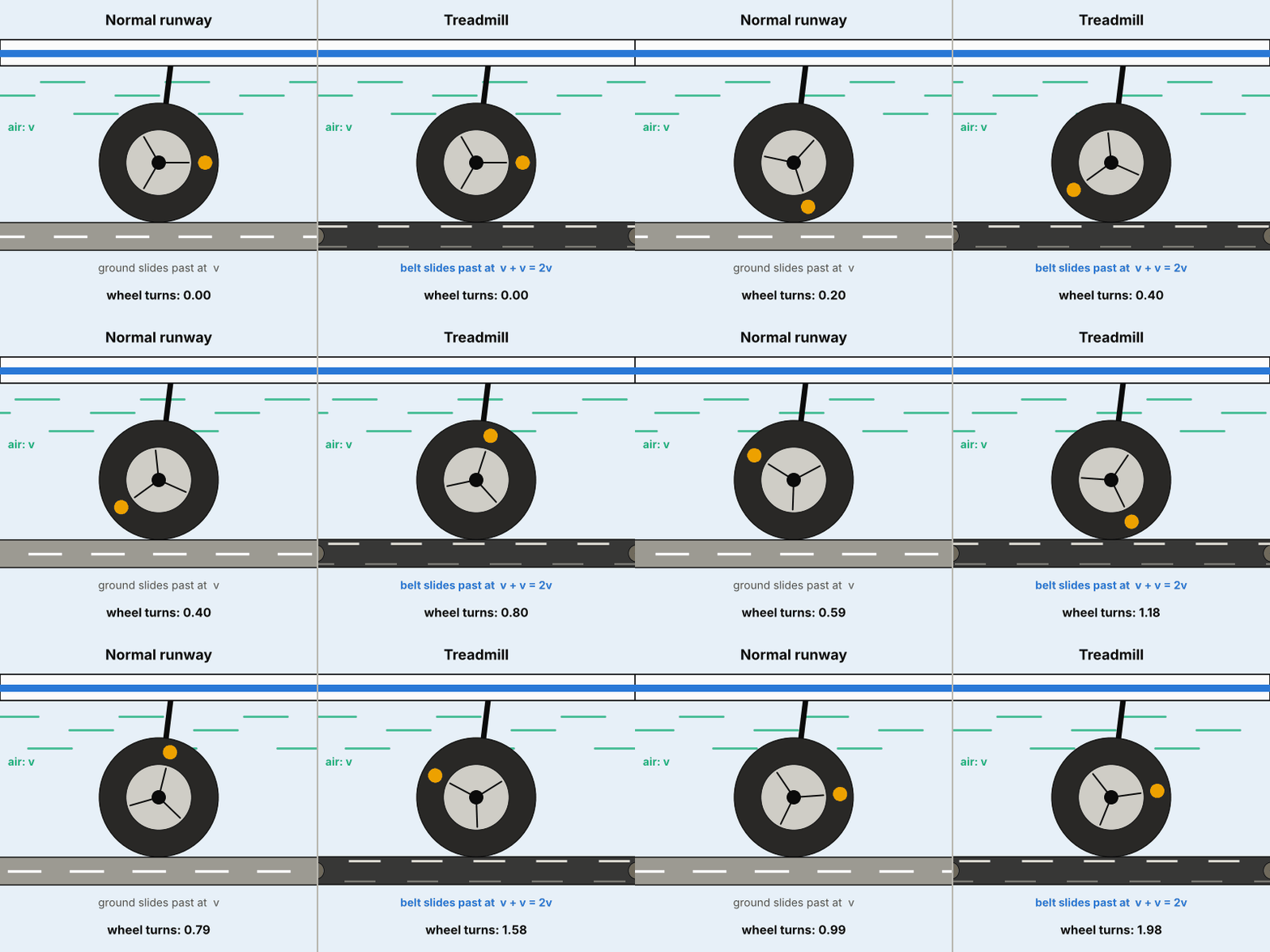
Animation 2. Seen from the airplane: the air flows past at the same speed in both cases, but the treadmill makes the wheel turn twice as often.
At a lift-off speed of 100 km/h, a Cessna main wheel (radius about 0.22 m) turns at roughly 1,200 rpm on a normal runway and 2,400 rpm on the treadmill. That is well inside what light-aircraft tires are built for; they are typically rated for around 250 km/h, about 3,000 rpm.
4. Lift needs airflow, not ground speed
A wing makes lift because air flows over it. The lift equation is:
L = ½ × ρ × v2 × S × CL
where ρ is the air density (1.225 kg/m³ at sea level), v is the airspeed, S is the wing area (16.2 m² for a Cessna 172) and CL is the lift coefficient, about 1.4 with take-off flaps set.
At 28 m/s (100 km/h) this gives L ≈ ½ × 1.225 × 28² × 16.2 × 1.4 ≈ 10,900 N, just enough to lift the airplane's 10,800 N weight. The key word is airspeed. In still air, the airspeed is the airplane's speed over the ground. The belt only moves a thin film of air right at its surface, a few centimeters thick, nowhere near the wings. So once the thrust has pushed the airplane up to 100 km/h relative to the air, the wings lift it off, whatever the belt underneath is doing.
5. The numbers: take-off run with and without the treadmill
To put real numbers on it, we simulated the take-off run of a Cessna 172 class airplane step by step, once on a normal runway and once on a Reading A treadmill.
| Model input | Value used |
|---|---|
| Mass | 1,100 kg (weight 10.8 kN) |
| Thrust | 2,000 N at rest, falling to about 1,750 N at lift-off |
| Air drag | 0.75 m² drag area (about 350 N at lift-off) |
| Rolling resistance | μ = 0.02, rising slightly with wheel spin speed |
| Wheel inertia | equivalent to 12 kg at the rim, all three wheels |
| Lift-off speed | 28 m/s (about 55 knots, 100 km/h) |
| Result | Normal runway | Treadmill |
|---|---|---|
| Time to lift-off | 20.3 s | 20.8 s |
| Take-off roll distance | 302 m | 310 m |
| Wheel rim speed at lift-off | 100 km/h | 200 km/h |
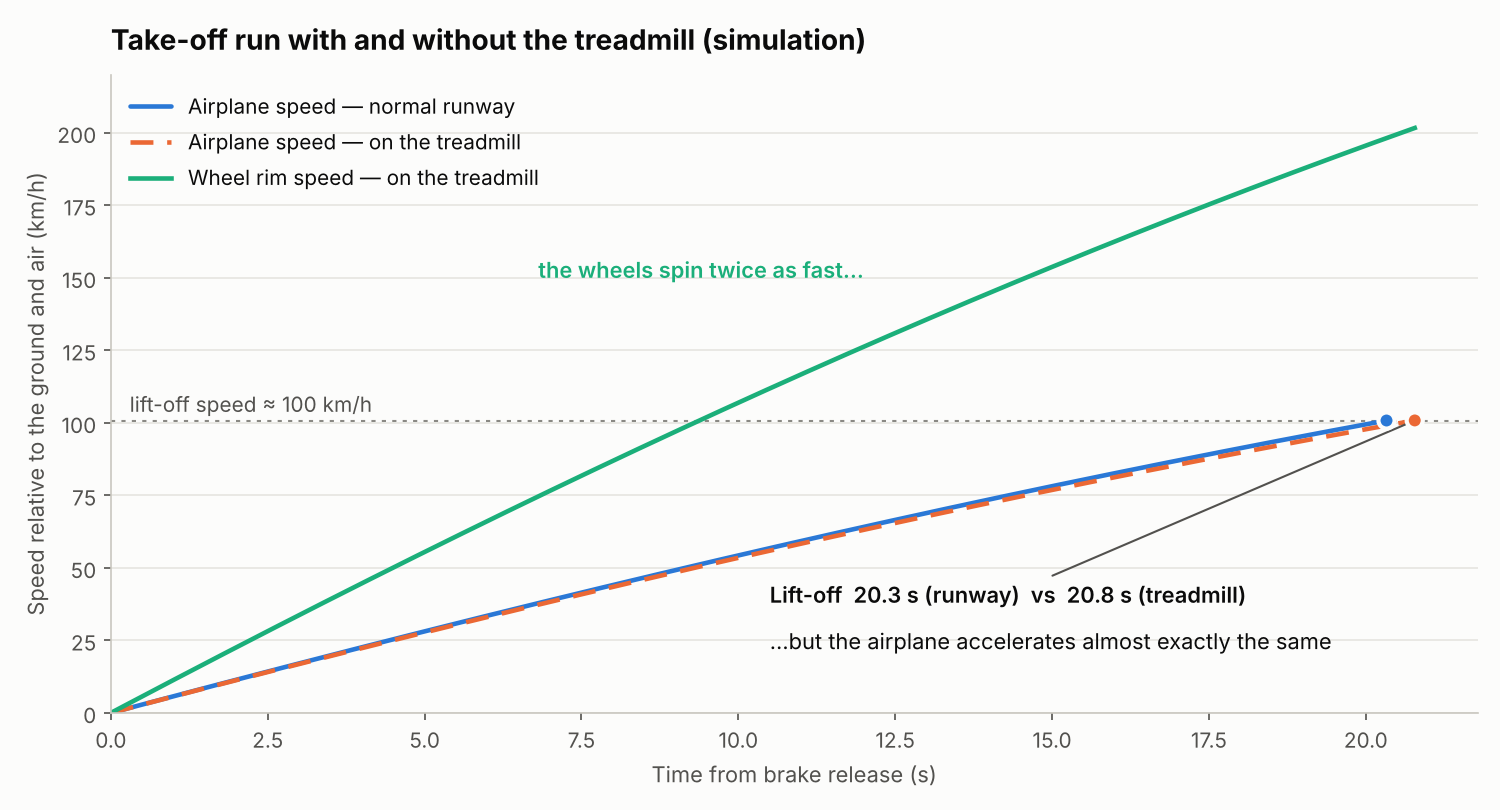
Figure 5. The airplane's speed rises almost identically in both cases. Only the wheels feel the treadmill.
The treadmill costs about half a second and eight meters, only 2 to 3% of the run, because of the extra tire losses and the effort of spinning the wheels up to twice the speed. That is less than the difference between a light and a heavy fuel load. Note that the airplane needs about 300 m of moving belt, so the treadmill has to be as long as a real runway.
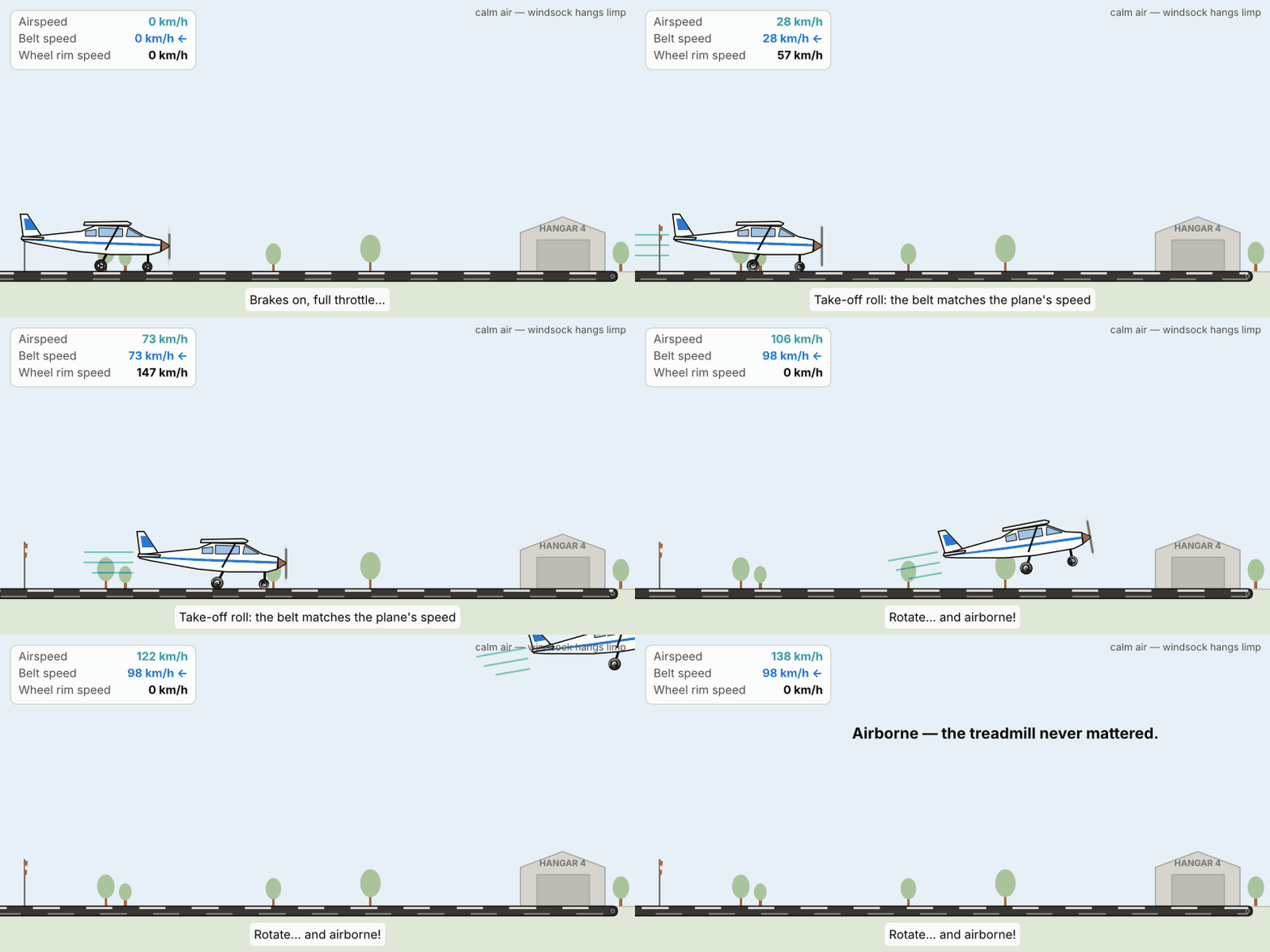
Animation 3. The belt runs backward at the airplane's speed, the wheels blur, and the airplane takes off anyway.
6. The trick reading: "the belt matches the wheel speed"
Now Reading B. Suppose the belt is told to always match the speed of the wheels' rims. From section 3:
rim speed = v + vbelt, and we demand vbelt = rim speed
Put those together and the only solution is v = 0: the airplane must stand still. But what could hold it still? Thrust is pushing it forward with 2,000 N. The only grip a free-rolling wheel has is through its bearings and its own inertia. The belt can resist the airplane by constantly spinning the wheels up faster and faster, because making a heavy wheel spin faster takes force. That force is:
F = meff × abelt
where meff is the wheels' rotational inertia expressed as an equivalent mass at the rim, about 12 kg for all three wheels. To cancel 2,000 N of thrust, the belt must accelerate at about 167 m/s², which is 17 g, and keep doing it without stopping.
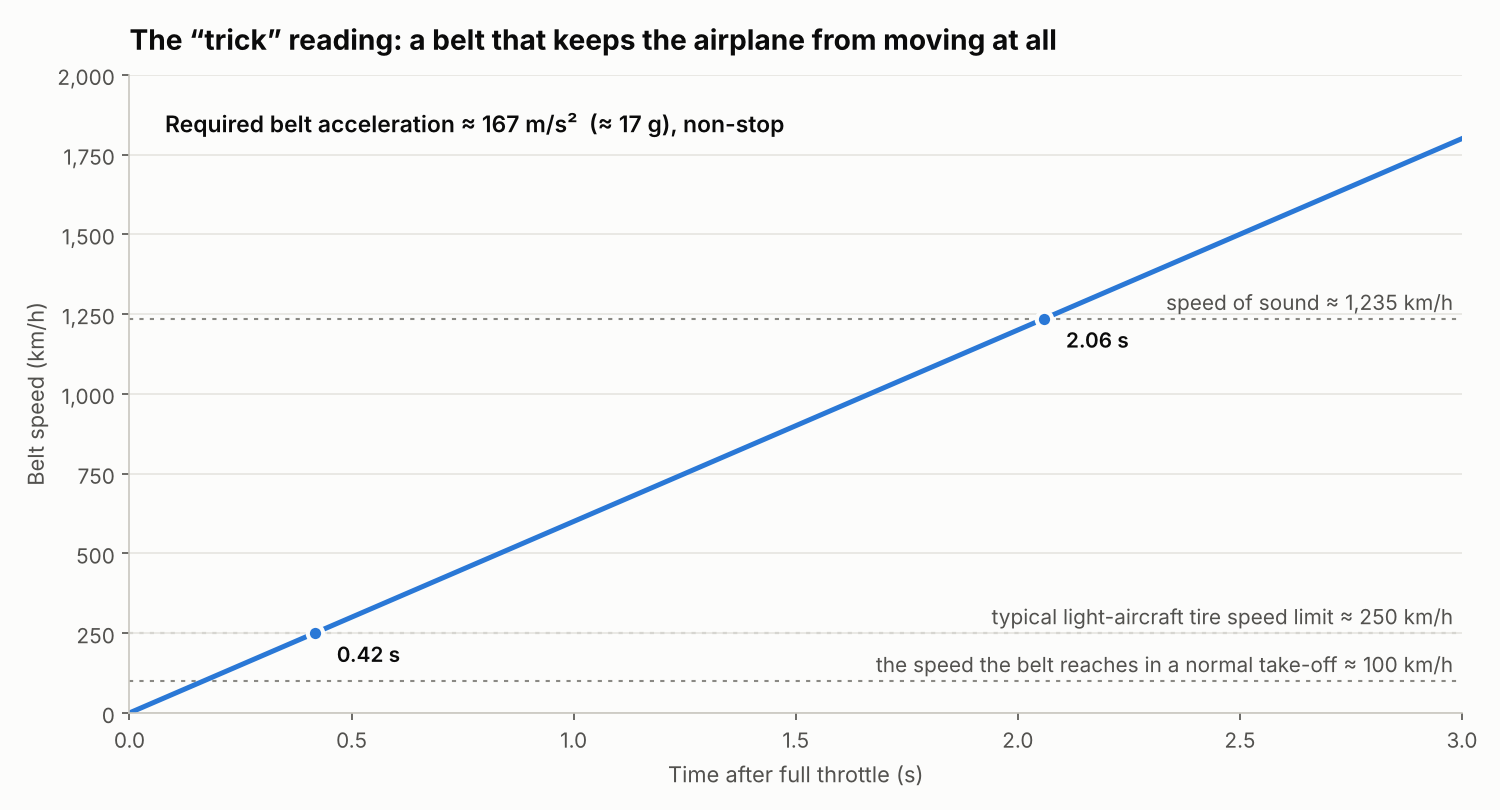
Figure 6. A belt that tries to pin the airplane in place passes the tires' speed limit in under half a second and the speed of sound in about two seconds.
After 0.42 s the belt passes the tires' speed limit of around 250 km/h. After about two seconds it passes the speed of sound. The tires and bearings would disintegrate in a fraction of a second, and an airplane on wrecked wheels is not an airplane taking off normally either. Reading B is therefore not a puzzle about aerodynamics. It describes an impossible machine whose only power over the airplane is to destroy its landing gear.
7. What would actually keep an airplane on the ground
It helps to list the things that really would stop the take-off. Every one of them works by blocking the air or locking the wheels, never by moving the ground.
| Method | Why it works |
|---|---|
| Lock the wheel brakes | The tires now grip the belt, so the belt can drag the airplane backward, just like a car. |
| Tie the airplane down | The rope holds it against the thrust. |
| A tailwind as fast as the airplane | The air moves along with the airplane, so the airspeed, and the lift, stay at zero. |
| Reading B's impossible belt | Not by stopping the airplane, but by destroying its wheels. |
The opposite is true too: moving the air helps. That is why aircraft carriers steam into the wind during launches and why pilots always take off into the wind. A headwind adds airspeed for free; a moving runway adds nothing.
Try It Yourself
You need a toy airplane or car with free-spinning wheels, a long sheet of paper or a towel, and a friend.
- Lay the paper on a table and put the toy on it.
- Rest one fingertip lightly behind the toy. Your finger plays the role of the propeller.
- Ask your friend to pull the paper towards themselves, slowly at first, then fast.
- Push the toy forward with a steady, gentle force while the paper moves.
The wheels spin furiously, but the toy goes exactly where your finger pushes it. You will barely feel the paper at all.
Key Takeaways
- A car pushes on the ground; an airplane pushes on the air. That single difference decides the puzzle.
- An airplane's wheels are free-rolling and can pass only a small force, about a tenth of the thrust, to the airplane.
- On the treadmill the wheels spin twice as fast, but the airplane accelerates almost exactly as on a normal runway.
- Lift depends on airspeed, and a moving belt does not move the air around the wings.
- The "match the wheel speed" version describes a belt that would have to accelerate at 17 g and break the sound barrier in two seconds. It cannot stop a take-off; it can only wreck the wheels.
Numbers in this article come from a simplified model of a Cessna 172 class airplane and are meant to illustrate the physics, not to replace a pilot's operating handbook.